


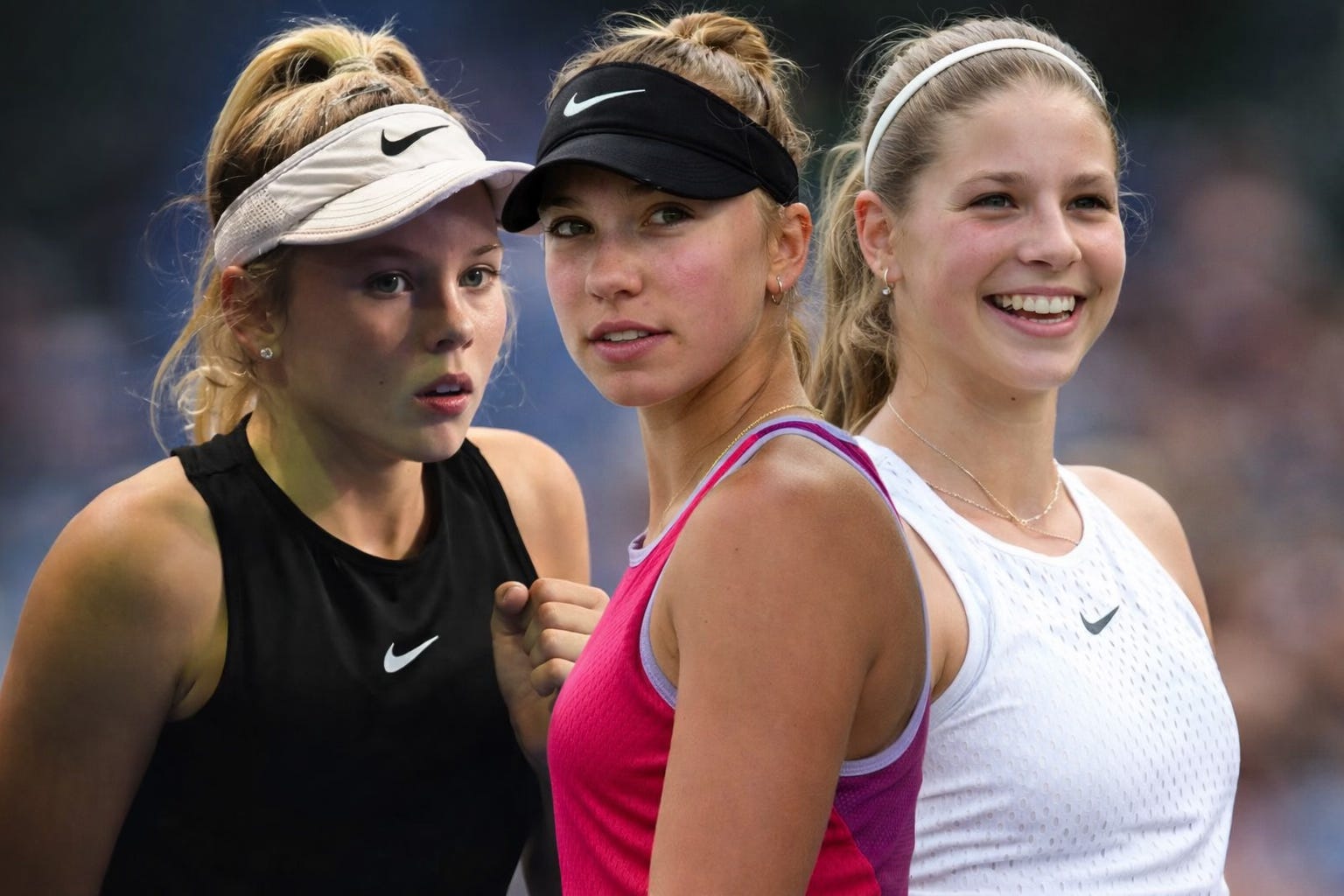
Generational change in women’s tennis never waits. While players like Aryna Sabalenka, Elena Rybakina, Iga Świątek and Coco Gauff continue to lead the tour, a new wave of talent is already rising behind them, ready to take center stage.
Among them, three names—all born in 2009—are emerging strongly on the international junior scene: Ksenia Efremova, Kristina Penickova and Hannah Klugman. Three different profiles, but with one very clear common denominator: the potential to reach the very top. Even the world’s top 10.
Efremova, the most spectacular: talent and aggression of a future star
When it comes to pure talent, Ksenia Efremova is probably the most advanced of the three. The daughter of a former player (her mother is ex-tennis player Julia Efremova), the young French player—Russian-born—has already made her mark in the biggest junior tournaments, imposing herself with an aggressive, fast, modern style of tennis. This year, for example, she won the Australian Open Junior title.
Her trademark is taking the ball early: she steps into rallies with incredible timing, moves forward whenever possible and isn’t afraid to take risks. An approach that can make a real difference in today’s game.
The feeling is that her “ceiling” is the highest of the group. If she handles the transition to the professional circuit, her rise to the elite could be very rapid.
She currently trains at the Mouratoglou Tennis Academy in the south of France.
Penickova, the most solid: a No.1 built to last
Less flashy but more effective, Kristina Penickova represents consistency at its best. The world No.1 junior—and also the daughter of former players (her parents are Tomáš Pěnička and Olga Hostáková, both former Czech players)—the American has built her rise on consistent results and a very complete game.
She may not have a single standout weapon like some of her peers, but she also has no obvious weaknesses. She can sustain rallies, defend well and accelerate when needed. Above all, she makes very few mistakes.
She is the classic profile that climbs the rankings almost quietly over time. And often, these are the players who end up establishing themselves among the very best in the world.
In 2025, she reached the Australian Open Junior singles final and won the doubles title. Still in doubles, she also won Wimbledon Junior.
Klugman, the most intelligent: technique and vision beyond her years
Hannah Klugman stands out for her maturity. Not just clean technique, but above all her ability to read the game, construct points and adapt to different situations.
The British player always seems to have a plan. She doesn’t force—she chooses. She doesn’t improvise—she builds. A rare approach at such a young age.
The real question mark is her physical development, which will be crucial in determining how far she can go. But from a tennis standpoint, the foundations are already those of a top-level player.
She is coached by Ben Haran, former coach of Daniel Evans and Jack Draper.
Last year in junior Grand Slams, she reached three finals: Roland Garros in singles, and the Australian Open and Wimbledon in doubles.
Three different paths, one possible shared destiny
Efremova, Penickova and Klugman represent three different ways of interpreting modern tennis: power and aggression, solidity and consistency, intelligence and vision.
The transition from junior to professional level remains the most delicate phase, and not all prospects manage to confirm expectations. But in their case, the signs are strong.
If they live up to their potential, the future of women’s tennis may already have three new names to remember.
And this time, not just in the junior circuit.