


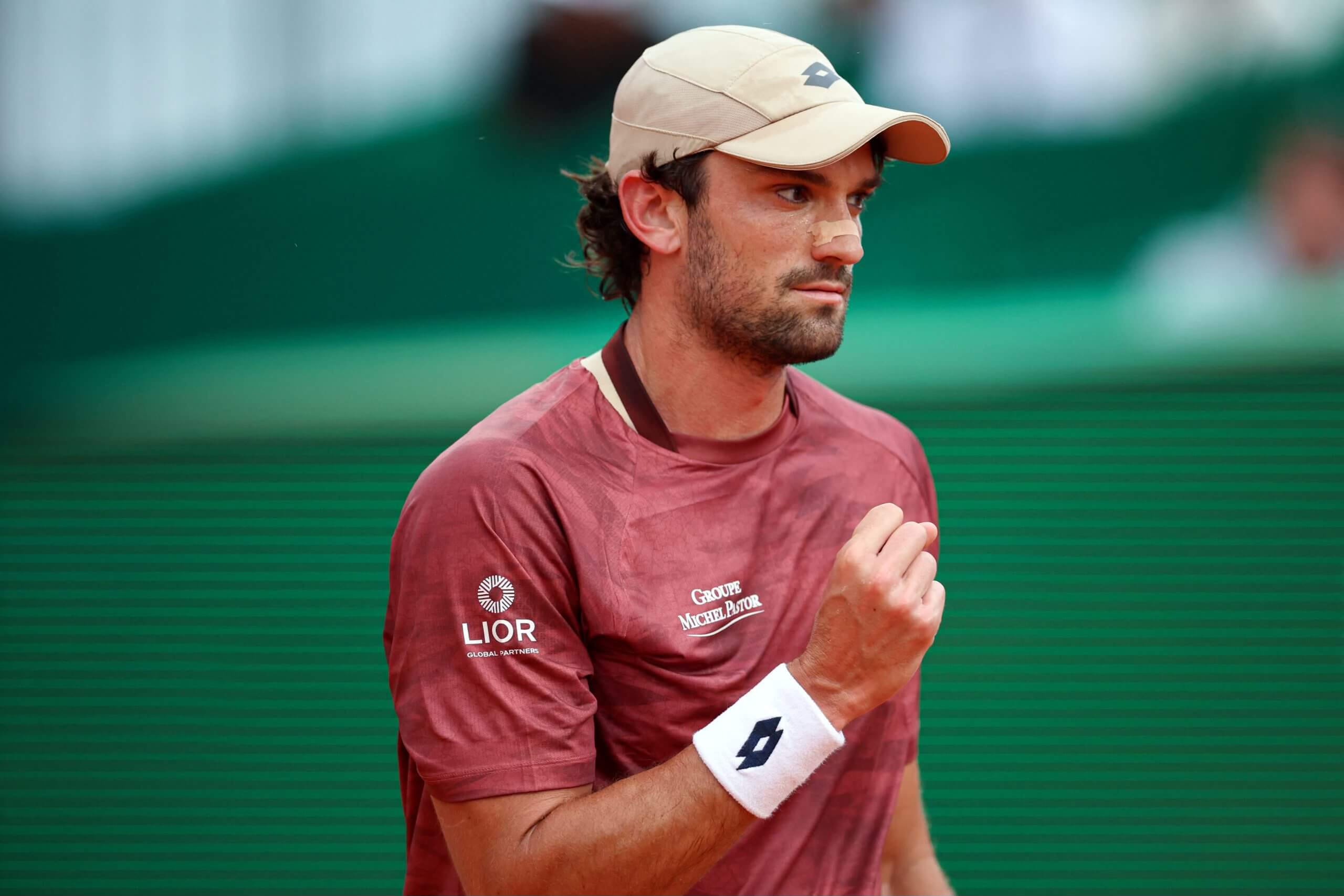
There are players who arrive early. And others who arrive when they’re ready.
Valentin Vacherot clearly belongs to the second category. His semifinal, at home in Monte Carlo, against Carlos Alcaraz was not just a surprise result: it was, so far, the highest point on clay of a quiet rise, built away from the spotlight and far from the fast-track trajectories of modern tennis.
The inevitable question is: why did this breakthrough only begin last year, at nearly 27?
Vacherot, who has now reached a career-high ranking of world No. 17, was never a teenage prodigy, nor a name that circulated among the sport’s hyped prospects. And yet, in recent months, something has changed. Clearly.
A first answer lies in his path. Like Rafael Jodar (whom I discussed in a previous article), the Monegasque player chose college tennis in the United States, attending Texas A&M University. A different, less high-profile environment, but an extremely formative one. There, he built solid foundations: match rhythm, discipline, and the ability to handle daily competitive pressure.
That’s not a minor detail.
College doesn’t turn you into a champion, but it teaches you how to compete. And Vacherot came out of that system with one defining quality: consistency. Not isolated peaks, but a steadily rising average level.
The real leap, however, came in 2024, with three Challenger titles in the early months of the season. Then, at the end of 2025, the definitive breakthrough: first, the stunning victory at the Shanghai Masters 1000 — beating players like Rune and Djokovic — as world No. 204, and then a quarterfinal run at the Paris Masters 1000, which propelled him into the top 30.
That’s when his tennis took a clear step forward. Greater baseline solidity, higher quality in long rallies, but above all a new ability to stay in matches even against stronger opponents. He doesn’t unravel, doesn’t lose structure. He holds.
And that is exactly what has made the difference on the clay of Monte Carlo as well.
On this surface, his game finds a natural balance. He is not a pure attacker, but neither is he a passive defender. He is a builder — someone who works the point, waits for the right moment, and when it comes, knows how to be decisive.
But the real point is not technical.
It’s mental.
Vacherot doesn’t look like he’s playing above his level. He looks like he’s playing exactly at his level. And in a tournament like Monte Carlo, that’s a huge advantage. He has nothing to prove, no expectations to carry. He plays freely, but not carelessly. There’s a difference.
So we return to the original question: why so late?
Perhaps because his is a game that needs time. It doesn’t rely on explosive power or overwhelming shot-making. It grows through repetition, through experience, through understanding the game. It matures.
And when it matures, it becomes extremely solid.
It’s no coincidence that many players with similar paths break through later than early phenoms. Less hype, less pressure, more construction. And when they arrive, they are often more ready to stay.
The semifinal against Alcaraz was, inevitably, a reality check. Not so much in terms of the result, but the level. Because that is how the gap between a surprise and a top player is measured.
But ultimately, the point is another.
Vacherot is no longer a surprise.
He is a player who has found his time.
And in tennis, that is often the only thing that truly matters.