


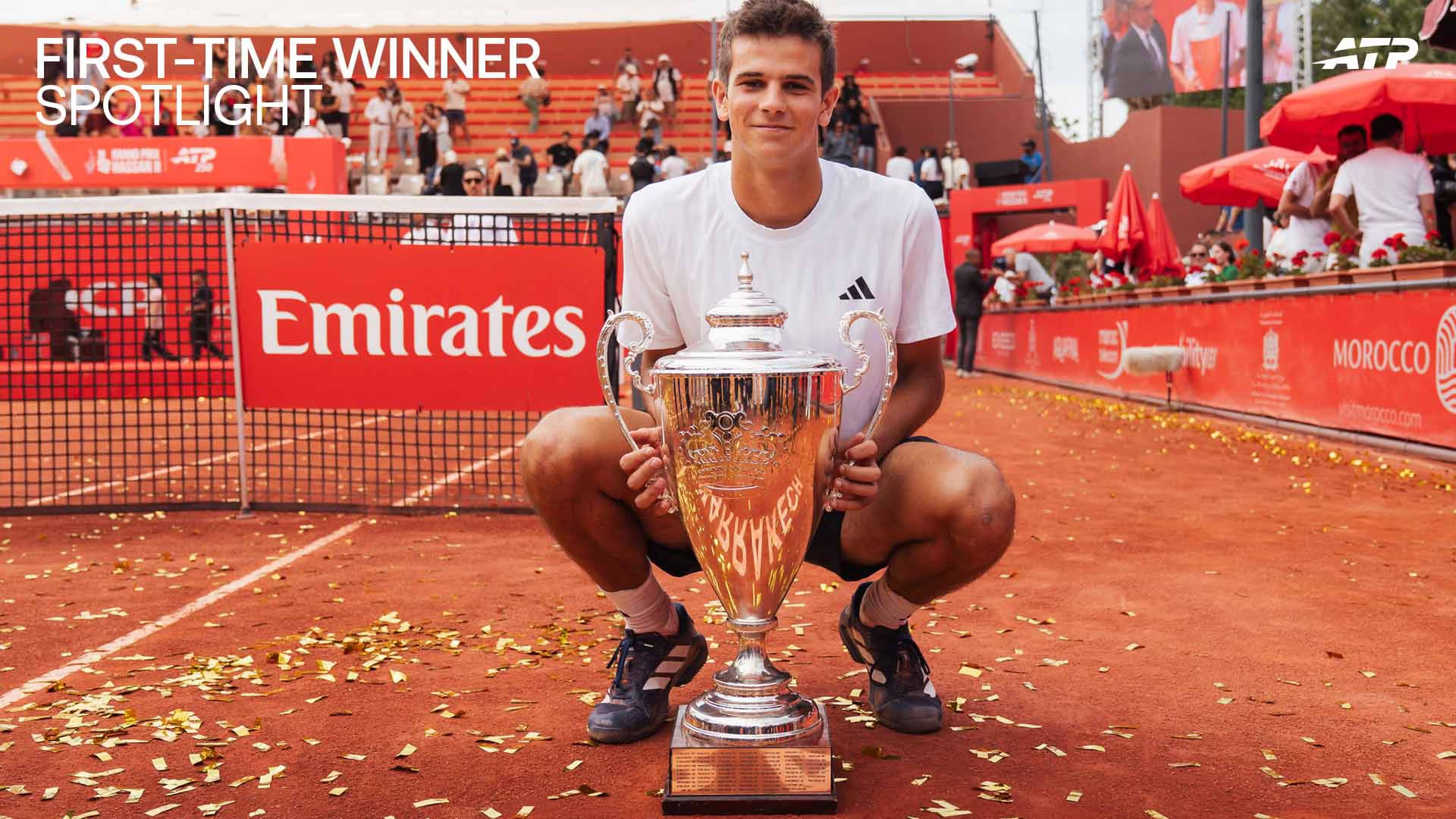
In tennis, there are many paths to the top. Some are linear, others more winding. And then there are those that look like detours — but turn out to be shortcuts. Rafael Jodar’s trajectory belongs to the latter.
At 19, with his 20th birthday coming in September, the Spaniard has just claimed his first ATP title in Marrakech. A result that didn’t come by chance, but as the natural consequence of a path built differently from the traditional Spanish model. And today, with his rise to world No. 57, what only a few months ago seemed like a surprising climb has become a concrete reality.
It’s not just about numbers. It’s about how those numbers were built.
Jodar didn’t come through clay courts. Or at least, not primarily. His development has taken place mostly on hard courts and faster surfaces — almost heresy for a Spanish player. But it is precisely in this choice that the key to his identity lies.
Like many of his peers from other countries, Jodar chose an alternative route: college tennis in the United States. His experience at the University of Virginia proved decisive. Not only for the level of competition, but for the environment: structured, demanding, where competitive pressure intertwines with personal growth.
Those who followed him during that phase didn’t talk so much about talent — which was clearly there — but about maturity. His college coach, Andres Pedroso, described him this way: “He was a complete player, but above all a mature competitor, a winner.”
That mental solidity became the foundation of his rise. “College helped me a lot, not just as a player but also as a person. It taught me how to compete every day,” Jodar himself said. His decision to leave college at the end of 2025 to fully commit to the professional circuit was the first key turning point. Not an impulsive move, but a conscious step: “I felt it was the right time to try.”
2025 was the breakthrough year. Three Challenger titles — all on hard courts — a major leap in the rankings and, above all, a growing feeling: that he could consistently belong at that level. Not a sudden explosion, but a gradual construction. Tournament after tournament, match after match.
The transition from college tennis to the ITF and then ATP circuit is one of the most difficult in modern tennis. The pace changes, the level of opponents rises, and so does the pressure. Jodar, however, absorbed the change naturally. The confidence built in Challenger events did the rest, allowing him to step into the ATP Tour with an already mature approach.
The start of 2026 was the natural continuation. The Next Gen Finals at the end of 2025 had already provided important signals, but it was at the Australian Open that real confirmation arrived: coming through qualifying, reaching the main draw, and securing his first Grand Slam win. “Playing a Slam was a dream, winning my first match was something special.”
Then Miami. Once again through qualifying, once again growing. Wins over Hanfmann and Vukic, a tough battle with Etcheverry. And above all, a clear message: Jodar belongs at this level.
But the real leap has come now.
His first ATP title is not just a trophy. It’s the moment when a player changes status — from promising prospect to a real presence on tour. And the fact that it came so early — and on a fast surface — reinforces the idea that his path is not episodic, but structured.
Today he is world No. 57. Just a few weeks ago, he was outside the top 100.
What stands out, beyond the results, is his mental strength. Jodar is a player who always seems to know what to do in key moments. He doesn’t panic, doesn’t force, doesn’t get carried away. This attitude is the result of an unconventional path that exposed him early to different environments and forced him to adapt.
Technically, his game is complete and balanced. He is not one-dimensional. He can construct points patiently, but also accelerate when needed. “I try to be solid and aggressive when necessary,” he explained — a perfect summary of his playing philosophy.
Within Spanish tennis, Jodar represents something different. Raised in Madrid, he is part of a new generation trying to find space alongside Carlos Alcaraz, but with a distinct identity. Less explosive, more constructed. Less tied to clay, more adaptable.
His name now sits alongside other young Spaniards like Landaluce, in a transitional phase for the country’s tennis movement. But his story stands apart. He did not follow the traditional path. And for that very reason, today, he seems to have different tools.
Perhaps more complete ones.
“The best players in the world accept who they are,” Pedroso once said. They accept their style, their strengths, their weaknesses, and every situation that occurs during a match. That is where the ability to stay present, point after point, is born.
Jodar has learned this lesson early.
And his first ATP title, more than a destination, feels like confirmation that the road he chose — different, less traveled — was the right one.
Where can it take him?
Perhaps higher than expected. And perhaps, sooner than anyone imagined.