


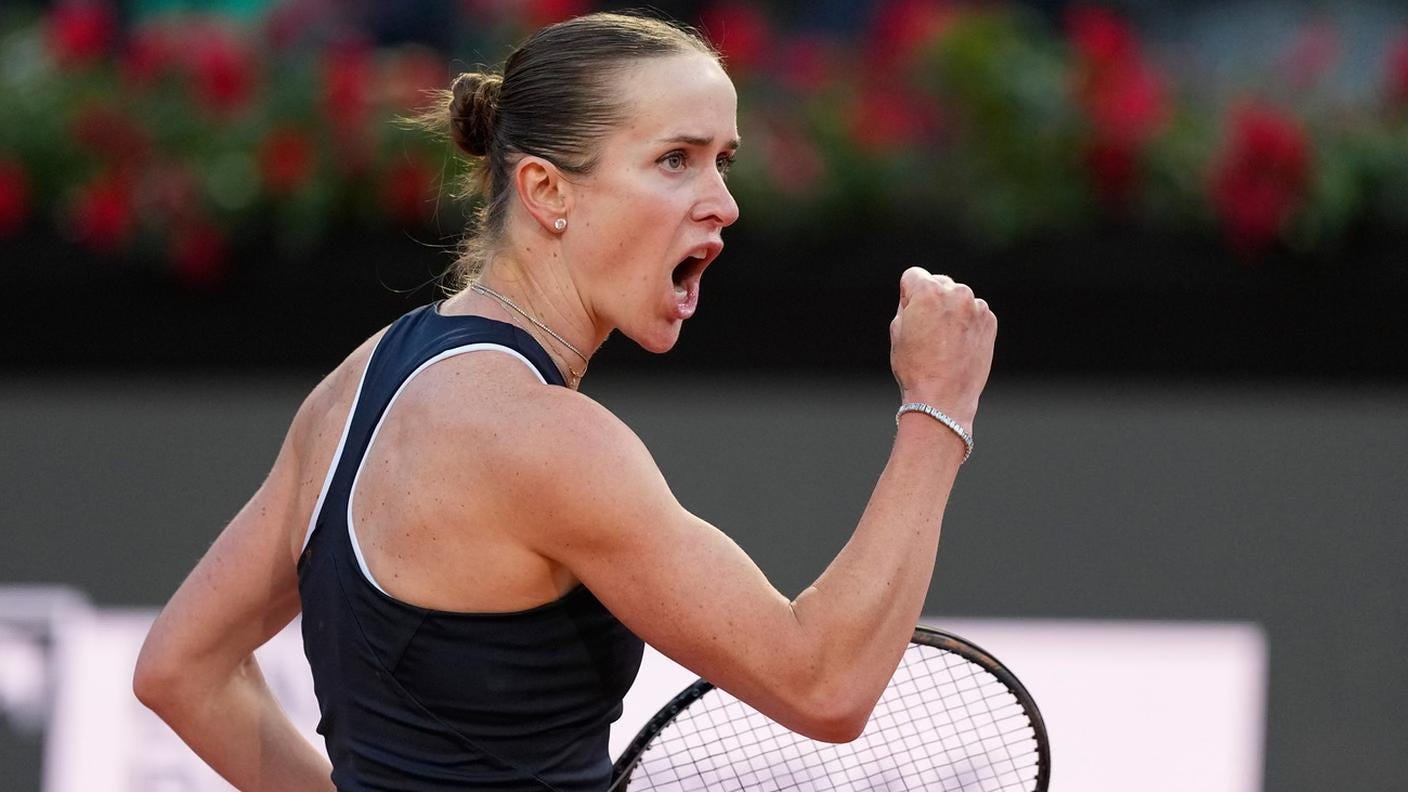
In modern tennis, where everything seems to move and fade so quickly, people almost get used to thinking that a career follows a precise timeline. A peak, a decline, then the constant arrival of a new generation.
Elina Svitolina, however, has just reminded everyone that it does not always work that way.
Her victory in Rome — her first Masters 1000 title in years and after motherhood — is not just an important success. It is something rarer: a second sporting life.
Because so much had happened in between.
The pregnancy, the birth of her daughter, the long break, the return filled with doubts. And above all, one silent question that follows almost every player who becomes a mother: is it really possible to come back at the same level?
In recent years, women’s tennis has slowly begun to change the narrative around this subject. Serena Williams had already shown that a comeback was possible. Naomi Osaka reopened the conversation more recently. But every story remains different — personal, physical and mental all at once.
Svitolina’s story perhaps even more so.
Because her tennis is not built on overwhelming physical dominance or spectacular shot-making. It is based on rhythm, consistency, and the ability to mentally withstand every rally. And it is exactly this kind of tennis that often takes longer to recover after a long break.
For months, her comeback felt almost like a rebuilding process. Not so much technically, but emotionally. Rediscovering her level, but above all rediscovering the belief that she still belonged there.
And then, slowly, it happened.
First came the isolated signs. Then the important wins. The climb back into the Top 10. And finally Rome, where Svitolina once again looked like the player who for years had been a constant presence at the top of women’s tennis: composed, incredibly solid, almost impossible to move mentally.
And that is perhaps the most impressive part of all.
She did not win “thanks to experience.”
She won by playing real, competitive, modern tennis.
In a tour that keeps getting younger and more physical, Svitolina managed to return not as a nostalgic symbol, but as a player who is still relevant at the highest level.
And that completely changes the perspective.
Because her success says something that goes beyond a single tournament. It speaks about a women’s game that is slowly learning to see motherhood not as an inevitable ending, but as a phase of a career.
Not simple. Not automatic. But possible.
The victory in Rome does not erase the difficulties she has faced over the last few years. But it gives a different meaning to the entire journey.
Svitolina did not simply return to winning.
She returned to feeling part of the elite again.
And perhaps that is the most important achievement of all.