


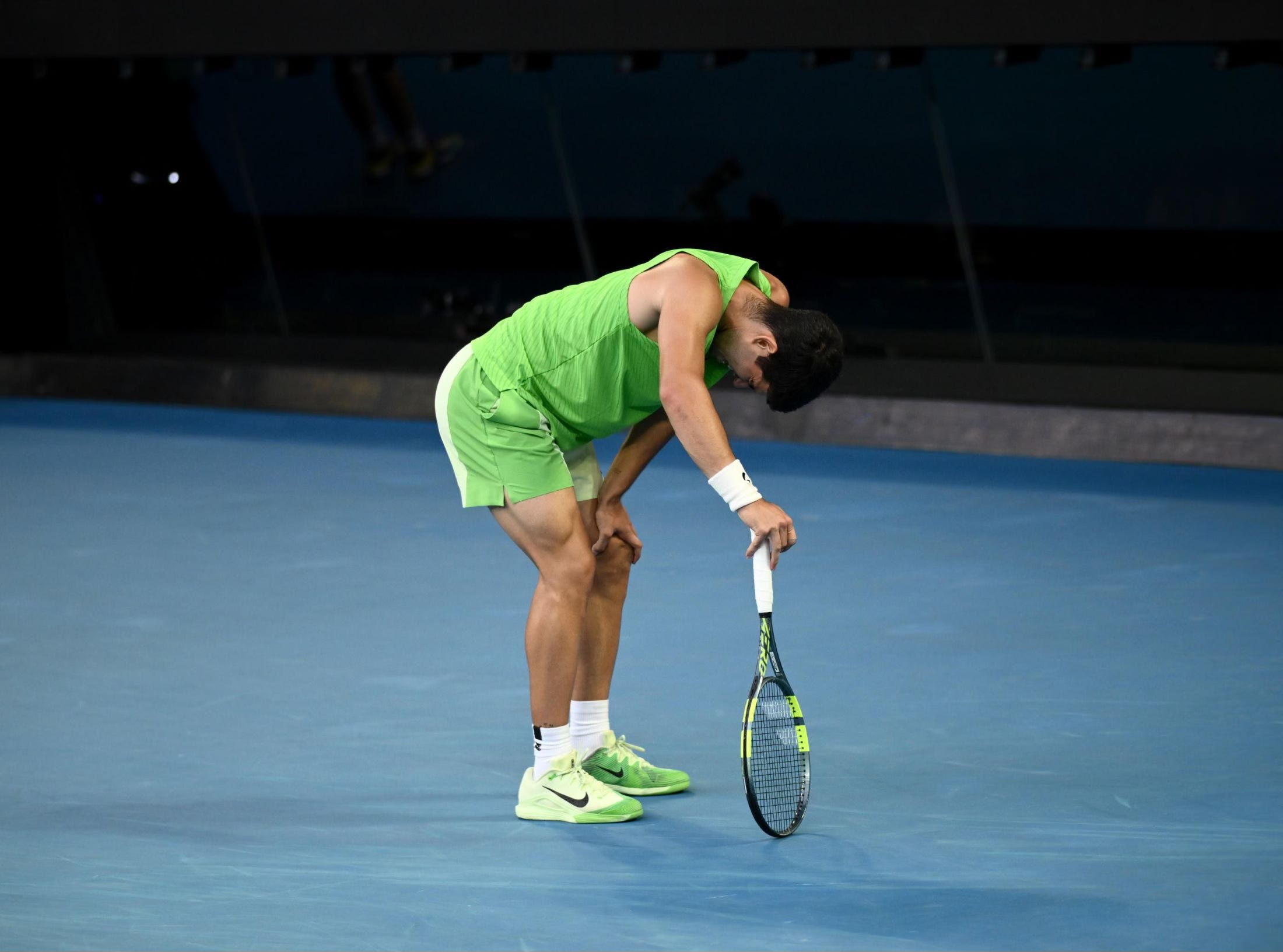
Until just a few weeks ago, Carlos Alcaraz’s 2026 season seemed destined to go down as one of the most dominant in history. His victory at the Australian Open – which secured him the Career Grand Slam at just 22 years old – and his emphatic title in Doha reinforced a clear feeling: at that moment, tennis had an undisputed ruler.
Then, suddenly, something cracked.
Between Indian Wells and Miami, the two tournaments that traditionally reflect the form of top players in the early part of the season, Alcaraz showed unexpected weaknesses. His semifinal loss to Medvedev in California can be seen as almost physiological: he was facing one of the toughest opponents on hard courts. But the third-round exit in Miami against Korda had a very different flavor. More than a setback, it felt like a signal.
The inevitable question is: what is really going on?
A first explanation is physical. Alcaraz comes from intense months, with an almost perfect start to the season and a workload of extremely high-intensity matches. Sixteen consecutive wins. His explosive, high-energy playing style leaves little margin: when even a small percentage of sharpness is missing, the entire system is affected.
But stopping there would be reductive.
There is also a mental aspect. After achieving a milestone as significant as the Career Grand Slam, it is natural – even for a phenomenon – to experience a phase of physiological “emptiness.” The hunger that takes you to the top is not always the same one that keeps you there, at least in the short term. And the United States, with its media pressure and sky-high expectations, amplifies every minor dip.
He may also have felt some pressure from the growing comparisons: after those 16 consecutive wins, analysts had already started drawing parallels with Novak Djokovic’s extraordinary record of 43 straight victories between late 2010 and early 2011 (essentially winning every tournament he played) before being stopped in the Roland Garros semifinal.
That the mental factor plays a major role is beyond doubt. The Spaniard showed clear signs of frustration both in Indian Wells and Miami. “Sometimes I get tired of playing against Roger Federer in every round,” he said after a tough third-round win over Rinderknech, later adding: “It really feels like my opponents play at an incredible level… I have the feeling it always happens against me.” The nervousness was also evident in the match lost to Korda. Turning to his box, he said: “I can’t take it anymore, I want to go home right now!” All signs that something is not quite right.
Then there is the tactical issue. Opponents are learning. More and more. Against Alcaraz, clear patterns are emerging: slowing down the pace, extending rallies, taking time away from him. Medvedev executed this plan perfectly. Korda, despite having different characteristics, replicated some of these solutions, producing an almost flawless performance.
Finally, a detail that is often overlooked: the surface. Indian Wells and Miami, while both played on hard courts, present very different conditions compared to Melbourne or Doha. Bounce, speed, humidity: factors that matter more than it seems, especially for a player who relies heavily on timing and aggression.
So, are we looking at a warning sign?
Probably not. Rather, it is an inevitable phase in the growth – and management – of a champion who has accelerated every step of his career. Alcaraz remains the benchmark of the tour, but this brief dip is a reminder of a simple truth: in modern tennis, dominating without interruptions is almost impossible.
The real answer will come in the coming months, on clay. That is where we will understand whether this was just an episode… or the beginning of a new phase.